Customer expectations have moved beyond speed and convenience. Today, consumers expect brands to:
- Understand Their Preferences
- Anticipate Needs
- Deliver Personalized Experiences At Every Touchpoint
This has made Artificial Intelligence (AI) and Machine Learning (ML) essential to modern customer experience strategies.
By analyzing large volumes of customer data in real time, AI in customer experience enables businesses to shift from reactive support to predictive, customer-centric engagement.
In this blog, we highlight how AI and ML are enhancing the customer experience through personalization, intelligent automation, sentiment analysis, and proactive service.
Summarize this article with ChatGPT
Get key takeaways & ask questions
Key Customer Experience Challenges AI Is Solving
- Limited Ability to Personalize Customer Experiences at Scale
As customer bases grow, delivering personalized experiences becomes increasingly complex. Many businesses rely on generic messaging, which fails to address individual preferences and expectations.
- Slow Response Times and Long Resolution Cycles
When customers reach out for support, delayed responses and prolonged issue resolution quickly become major pain points. With rising expectations for prompt assistance, slow service directly impacts customer satisfaction, trust, and long-term loyalty.
- Poor Visibility into Customer Behavior and Preferences
Organizations often collect large volumes of customer data but struggle to convert it into meaningful insights. This lack of clarity prevents businesses from truly understanding customer needs and expectations.
- High Customer Churn Due to Unmet Expectations
When customer expectations are not consistently met, dissatisfaction builds over time. This often results in increased churn, especially in competitive markets where alternatives are easily available.
How AI and Machine Learning Are Transforming Customer Experience
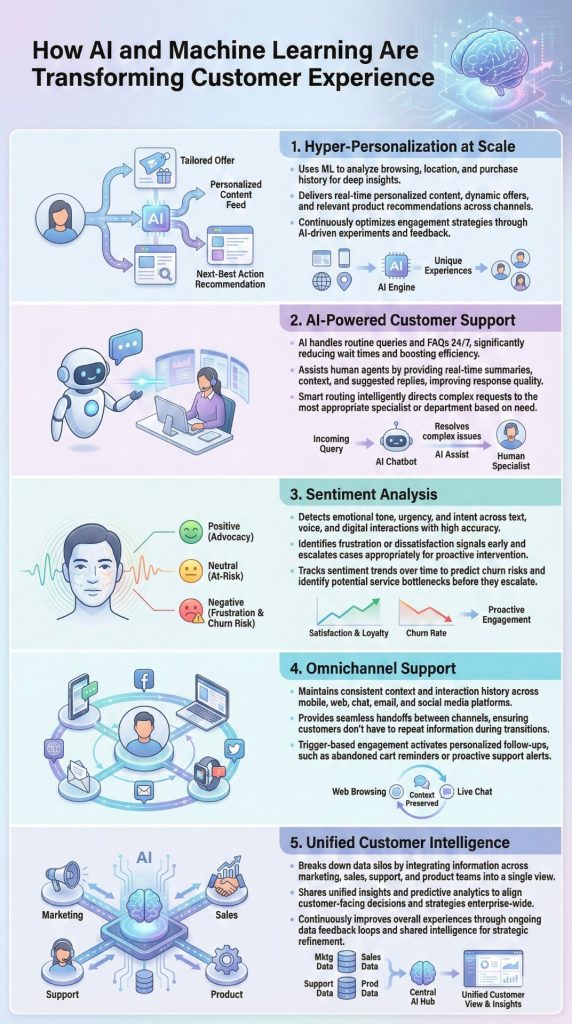
1. Hyper-Personalization at Scale
Hyper-personalization uses ML algorithms to analyze real-time data, such as browsing history, physical location, and past purchases, to create unique experiences for every individual. Unlike traditional segmentation, this occurs at an individual level for millions of customers simultaneously.
- Dynamic Content Delivery: Websites and apps now rearrange their interfaces, banners, and product grids in real-time based on the specific user’s intent and past preferences.
- Next-Best-Action (NBA) Engine: AI models suggest the most relevant next step for a user, whether it’s a specific discount code, a helpful tutorial video, or a product recommendation, increasing conversion by providing value rather than noise.
- Real-Time Experimentation and Optimization: AI continuously tests and refines personalization strategies, automatically learning which combinations of content, timing, and format drive the highest engagement and satisfaction.
To master these complex technical implementations, the Post Graduate Program in AI & Machine Learning: Business Applications provides professionals with a comprehensive curriculum covering supervised and unsupervised learning, deep learning, and neural networks.
This technical foundation enables practitioners to design and deploy the algorithms necessary for advanced recommendation engines and predictive modeling that power modern hyper-personalization.
2. AI-Powered Customer Support
Modern AI-driven support leverages Generative AI and deep learning to resolve complex issues without human intervention while maintaining a natural, empathetic tone.
- 24/7 Intelligent Resolution: AI agents can now handle complete workflows—like processing a refund, changing a flight, or troubleshooting hardware—rather than just pointing users to an FAQ page.
- Agent Assistance (Co-piloting): For issues requiring a human, AI works in the background to provide the agent with a summary of the customer’s history, sentiment, and suggested “best replies” to speed up resolution.
- Smart Routing: ML analyzes the language and urgency of an incoming ticket to automatically route it to the specialist best equipped to handle that specific topic, reducing “transfer fatigue.
3. Sentiment Analysis
AI-driven sentiment analysis goes beyond understanding what customers say to interpreting how they feel. Using advanced NLP, it identifies emotional tone, urgency, and intent across customer interactions, enabling more empathetic and effective responses.
- Emotion-Aware Routing: When AI detects signals such as frustration, anger, or urgency in emails, chats, or calls, it can automatically prioritize the case and route it to trained human specialists equipped to handle sensitive situations.
- Voice of Customer (VoC) at Scale: AI analyzes millions of reviews, surveys, support tickets, and social media posts to uncover emerging themes, sentiment trends, and shifts in customer expectations without manual effort.
- Predictive Sentiment Insights: By tracking sentiment patterns over time, AI can forecast potential dissatisfaction, churn risks, or service bottlenecks before they escalate.
4. Omnichannel Support
Modern customers expect seamless continuity across channels, starting a conversation on social media and completing it over email or chat without repeating information. AI enables this by unifying interactions across platforms and maintaining contextual intelligence.
- Unified Customer View: AI consolidates data from CRM systems, social platforms, mobile apps, and web interactions to provide a real-time, 360-degree view of the customer journey.
- Cross-Channel Context Preservation: Conversations, preferences, and past actions are retained across touchpoints, ensuring consistent and informed responses regardless of the channel.
- Intelligent Trigger-Based Engagement: AI identifies behaviors such as cart abandonment or repeated product views and automatically initiates personalized follow-ups via SMS, WhatsApp, email, or in-app notifications.
5. Efficient Use of Customer Data Across Teams
Delivering a superior customer experience requires more than collecting data; it demands seamless collaboration across teams. AI and Machine Learning enable organizations to break down data silos and ensure that customer insights are shared, actionable, and consistently applied across departments.
- Aligned Cross-Functional Decisions: Data-driven insights help teams coordinate messaging, offers, and support strategies, ensuring customers receive a cohesive experience at every stage of the journey.
- Continuous Experience Optimization: Feedback and engagement data shared across teams allow AI models to refine recommendations, improve service quality, and adapt experiences based on evolving customer expectations.
- Unified Customer Intelligence Framework: AI integrates data from marketing, sales, support, and product teams into a consolidated intelligence layer, enabling a consistent and accurate understanding of customer behavior and preferences.
For leaders and managers looking to integrate these technologies, the No Code AI and Machine Learning: Building Data Science Solutions offers a strategic pathway. This program focuses on using no-code tools to build AI models for applications like recommendation engines and neural networks.
It empowers professionals to utilize data for predictive analytics and automation, ensuring they can lead AI initiatives and improve customer experiences without a programming background.
AI In Customer Experience Use Cases
1. Starbucks: “Deep Brew” and Hyper-Personalization
Starbucks uses its proprietary AI platform, Deep Brew, to bridge the gap between digital convenience and the “neighborhood coffee shop” feel. The system analyzes vast amounts of data to make every interaction feel bespoke.
- Impact: Deep Brew factors in local weather, time of day, and inventory to provide real-time, personalized recommendations via the Starbucks app.
- Customer Experience: If it’s a hot afternoon and a store has high inventory of oat milk, the app might suggest a personalized “Oatmilk Iced Shaken Espresso” to a user who previously showed interest in dairy-free options.
- Result: Digital orders now account for over 30% of all transactions, driven mainly by the relevance of these AI-generated offers.
2. Netflix: Predictive Content Discovery
Netflix remains the gold standard for using Machine Learning to eliminate “choice paralysis.” Their recommendation engine is a complex system of neural networks that treats every user’s homepage as a unique product.
- Impact: Over 80% of all content viewed on the platform is discovered through AI-driven recommendations rather than manual searches.
- Customer Experience: Beyond just recommending titles, Netflix uses ML to personalize artwork. If you frequently watch romances, the thumbnail for a movie might show the lead couple; if you prefer action, it might show a high-intensity stunt from the same film.
- Result: This hyper-personalization significantly reduces churn and increases long-term subscriber retention.
Key Considerations for Companies to Maintain Trust in Customer Experience
As organizations increasingly rely on AI to enhance customer experience, ethical adoption becomes a strategic responsibility rather than a technical choice. Companies must ensure that AI-driven interactions are trustworthy, fair, and aligned with customer expectations.
- Ensure Transparency in AI Usage: Clearly disclose where and how AI is used in customer interactions, such as chatbots, recommendations, or automated decisions, to avoid misleading customers.
- Prioritize Data Privacy and Consent: Establish robust data governance practices that respect customer consent, limit data usage to defined purposes, and comply with relevant data protection regulations.
- Actively Monitor and Reduce Bias: Regularly evaluate AI models for bias and inaccuracies, and use diverse, representative data to ensure fair treatment across customer groups.
- Ethical Vendor and Tool Selection: Evaluate third-party AI tools and vendors for compliance with ethical standards, data security practices, and transparency requirements.
Conclusion
AI and Machine Learning are redefining customer experience by making interactions more personalized, proactive, and seamless across touchpoints. When implemented responsibly, these technologies not only improve efficiency and responsiveness but also strengthen trust and long-term customer relationships.