In this article, you will learn why short-term context isn’t enough for autonomous agents and how to design long-term memory that keeps them reliable across extended timelines.
Topics we will cover include:
- The roles of episodic, semantic, and procedural memory in autonomous agents
- How these memory types interact to support real tasks across sessions
- How to choose a practical memory architecture for your use case
Let’s get right to it.
Beyond Short-term Memory: The 3 Types of Long-term Memory AI Agents Need
Image by Author
If you’ve built chatbots or worked with language models, you’re already familiar with how AI systems handle memory within a single conversation. The model tracks what you’ve said, maintains context, and responds coherently. But that memory vanishes the moment the conversation ends.
This works fine for answering questions or having isolated interactions. But what about AI agents that need to operate autonomously over weeks or months? Agents that schedule tasks, manage workflows, or provide personalized recommendations across multiple sessions? For these systems, session-based memory isn’t enough.
The solution mirrors how human memory works. We don’t just remember conversations. We remember experiences (that awkward meeting last Tuesday), facts and knowledge (Python syntax, company policies), and learned skills (how to debug code, how to structure a report). Each type of memory serves a different purpose, and together they enable us to function effectively over time.
AI agents need the same thing. Building agents that can learn from experience, accumulate knowledge, and execute complex tasks requires implementing three distinct types of long-term memory: episodic, semantic, and procedural. These aren’t just theoretical categories. They’re practical architectural decisions that determine whether your agent can truly operate autonomously or remains limited to simple, stateless interactions.
Why Short-term Memory Hits a Wall
Most developers are familiar with short-term memory in AI systems. It’s the context window that lets ChatGPT maintain coherence within a single conversation, or the rolling buffer that helps your chatbot remember what you said three messages ago. Short-term memory is essentially the AI’s working memory, useful for immediate tasks but limited in scope.
Think of short-term memory like RAM in your computer. Once you close the application, it’s gone. Your AI agent forgets everything the moment the session ends. For basic question-answering systems, this limitation is manageable. But for autonomous agents that need to evolve, adapt, and operate independently across days, weeks, or months? Short-term memory isn’t enough.
Even extremely large context windows simulate memory only temporarily. They don’t persist, accumulate, or improve across sessions without an external storage layer.
The agents getting traction (the ones driving adoption of agentic AI frameworks and multi-agent systems) require a different approach: long-term memory that persists, learns, and guides intelligent action.
The Three Pillars of Long-term Agent Memory
Long-term memory in AI agents takes multiple forms. Autonomous agents need three distinct types of long-term memory, each serving a unique purpose. Each memory type answers a different question an autonomous agent must handle: What happened before? What do I know? How do I do this?
Episodic Memory: Learning from Experience
Episodic memory allows AI agents to recall specific events and experiences from their operational history. This stores what happened, when it happened, and what the outcomes were.
Consider an AI financial advisor. With episodic memory, it doesn’t just know general investment principles; it remembers that three months ago, it recommended a tech stock portfolio to User A, and that recommendation underperformed. It recalls that User B ignored its advice about diversification and later regretted it. These specific experiences inform future recommendations in ways that general knowledge can’t.
Episodic memory transforms an agent from a reactive system into one that learns from its own history. When your agent encounters a new situation, it can search its episodic memory for similar past experiences and adapt its approach based on what worked (or didn’t work) before.
This memory type is often implemented using vector databases or other persistent storage layers, which enable semantic retrieval across past episodes. Instead of exact matching, the agent can find experiences that are conceptually similar to the current situation, even if the details differ.
In practice, episodic memory stores structured records of interactions: timestamps, user identifiers, actions taken, environmental conditions, and outcomes observed. These episodes become case studies that the agent consults when making decisions, enabling a form of case-based reasoning that becomes more refined over time.
Semantic Memory: Storing Structured Knowledge
While episodic memory is about personal experiences, semantic memory stores factual knowledge and conceptual understanding. This is the facts, rules, definitions, and relationships the agent needs to reason about the world.
A legal AI assistant relies heavily on semantic memory. It needs to know that contract law differs from criminal law, that certain clauses are standard in employment agreements, and that specific precedents apply in particular jurisdictions. This knowledge isn’t tied to specific cases it has worked on (that’s episodic), it’s general expertise that applies broadly.
Semantic memory is often modeled using structured knowledge graphs or relational databases where entities and their relationships can be queried and reasoned over. That said, many agents also store unstructured domain knowledge in vector databases and retrieve it via RAG pipelines. When an agent needs to know “What are the side effects of combining these medications?” or “What are the standard security practices for API authentication?”, it’s querying semantic memory.
The distinction between episodic and semantic memory matters for autonomous agents. Episodic memory tells the agent “Last Tuesday, when we tried approach X with client Y, it failed because of Z.” Semantic memory tells the agent “Approach X generally works best when conditions A and B are present.” Both are essential, but they serve different cognitive functions.
For agents working in specialized domains, semantic memory often integrates with RAG systems to pull in domain-specific knowledge that wasn’t part of the base model’s training. This combination allows agents to maintain deep expertise without requiring massive model retraining.
Over time, patterns extracted from episodic memory can be distilled into semantic knowledge, allowing agents to generalize beyond individual experiences.
Procedural Memory: Automating Expertise
Procedural memory is often overlooked in AI agent design, but it’s essential for agents that need to execute complex, multi-step workflows. This is the learned skills and behavioral patterns that the agent can execute automatically without deliberation.
Think about how you’ve learned to touch type or drive a car. Initially, each action required focused attention. Over time, these skills became automatic, freeing your conscious mind for higher-level tasks. Procedural memory in AI agents works similarly.
When a customer service agent encounters a password reset request for the hundredth time, procedural memory means it doesn’t need to reason through the entire workflow from scratch each time. The sequence of steps (verify identity, send reset link, confirm completion, log the action) becomes a cached routine that executes reliably.
Procedural memory doesn’t eliminate reasoning entirely. It reduces repetitive deliberation so reasoning can focus on novel situations.
This type of memory can emerge through reinforcement learning, fine-tuning, or explicitly defined workflows that encode best practices. As agents gain experience, frequently-used procedures move into procedural memory, improving response times and reducing computational overhead.
For autonomous agents executing complex tasks, procedural memory enables smooth orchestration. The agent handling your travel booking doesn’t just know facts about airlines (semantic) or remember your past trips (episodic), it knows how to execute the multi-step process of searching flights, comparing options, making reservations, and coordinating confirmations.
How the Three Memory Types Work Together
All three memory types work best when integrated. Consider an autonomous AI research assistant tasked with “Prepare a market analysis report on renewable energy investments.”
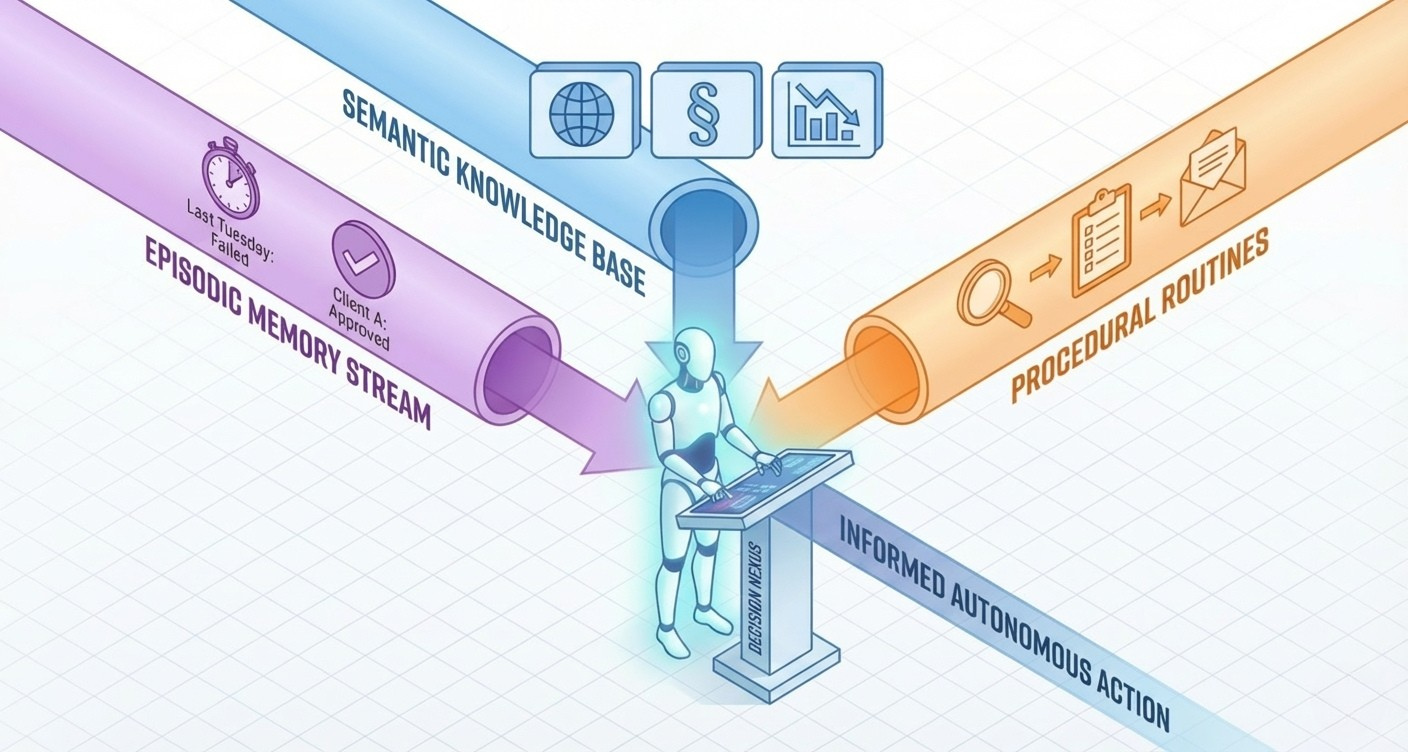
Episodic memory recalls that last month, when creating a similar analysis for the semiconductor industry, the user appreciated the inclusion of regulatory risk assessments and found the technical jargon off-putting. The agent also remembers which data sources proved most reliable and which visualization formats generated the best feedback.
Semantic memory provides the factual foundation: definitions of different renewable energy types, current market valuations, key players in the industry, regulatory frameworks across different countries, and the relationship between energy policy and investment trends.
Procedural memory guides execution: the agent automatically knows to start with market sizing, then move to competitive landscape analysis, followed by risk assessment, and conclude with investment recommendations. It knows how to structure sections, when to include executive summaries, and the standard format for citing sources.
Without all three working together, the agent would be less capable. Episodic memory alone would make it over-personalized with no general knowledge. Semantic memory alone would make it knowledgeable but unable to learn from experience. Procedural memory alone would make it good at executing programmed tasks, but inflexible when encountering new situations.
Choosing the Right Memory Architecture for Your Use Case
Not every autonomous agent needs all three memory types equally emphasized. The right memory architecture depends on your specific application.
For personal AI assistants focused on user personalization, episodic memory is most important. These agents need to remember your preferences, past interactions, and outcomes to provide increasingly tailored experiences.
For domain expert agents in fields like law, medicine, or finance, semantic memory matters most. These agents need deep, structured knowledge bases they can query and reason over reliably.
For workflow automation agents that handle repetitive processes, procedural memory is key. These agents benefit most from learned routines that can be executed at scale.
Many production systems (especially those built on frameworks like LangGraph or CrewAI) implement hybrid approaches, combining multiple memory types based on the tasks they need to handle.
The Path Forward
As we move deeper into the era of agentic AI, memory architecture will separate capable systems from limited ones. The agents that change how we work aren’t just language models with better prompts. They’re systems with rich, multi-faceted memory that enables true autonomy.
Short-term memory was sufficient for chatbots that answer questions. Long-term memory (episodic, semantic, and procedural) transforms those chatbots into agents that learn, remember, and act intelligently across extended timescales.
The convergence of advanced language models, vector databases, and memory architectures is creating AI agents that don’t just process information, but accumulate wisdom and expertise over time.
For machine learning practitioners, this shift demands new skills and new architectural thinking. Designing effective agents is no longer about prompt engineering alone. It’s about intentionally deciding what the agent should remember, how it should remember it, and when that memory should influence action. That’s where the most interesting work in AI is happening now.